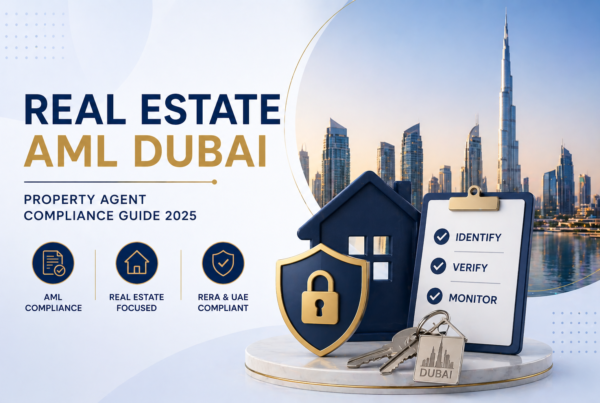

Why Real Estate is a DNFBP
Real estate transactions involve large sums, complex ownership structures, and cross-border payments—making them attractive to money launderers. That’s why UAE real estate brokers are classified as Designated Non-Financial Businesses and Professions (DNFBPs) under AML regulations.
The Real Estate Money Laundering Risk
Property transactions offer criminals several advantages:
- High value: Single transactions can launder millions
- Legitimate appearance: Property investment seems normal
- Price manipulation: Over/under-valuation hides illicit funds
- Complex ownership: Shell companies and trusts obscure UBOs
- Cross-border: International buyers complicate tracing
UAE Regulatory Requirements
Real estate brokers must comply with:
- Federal Decree-Law No. 20 of 2018: AML/CFT framework
- Cabinet Decision No. 10 of 2019: DNFBP implementation
- DLD regulations: Dubai Land Department guidelines
- SCA rules: Securities and Commodities Authority
Customer Due Diligence (CDD)
For every transaction, brokers must verify:
Individual Buyers
- Full name and date of birth
- Nationality and residency status
- Government-issued ID (passport, Emirates ID)
- Source of funds
- Occupation and employer
Corporate Buyers
- Company registration documents
- Trade license
- Memorandum and Articles of Association
- Ultimate Beneficial Owners (UBOs)
- Authorized signatories
- Corporate structure chart
Tracefort for Real Estate Brokers
Tracefort provides purpose-built AML solutions for UAE real estate DNFBPs:
Tracefort Shield: Instant Screening
- PEP screening: Identify politically exposed persons in seconds
- Sanctions checks: Real-time UN, OFAC, EU, UAE local lists
- Adverse media: Continuous negative news monitoring
- UBO discovery: Map corporate ownership structures
- Batch screening: Process multiple clients simultaneously
Tracefort Pulse: Transaction Monitoring
- Cash threshold alerts: Automatic flagging above AED 55,000
- Pattern detection: Identify structuring and layering
- Client risk scoring: Dynamic risk profiles
- Audit trails: Complete documentation for regulators
- goAML ready: Direct STR submission
Enhanced Due Diligence (EDD)
EDD is required for:
- Cash transactions over AED 55,000
- Politically Exposed Persons (PEPs)
- High-risk jurisdictions
- Complex ownership structures
- Unusual transaction patterns
Tracefort Shield automates EDD with enhanced screening and source of wealth verification.
Red Flags in Real Estate
Watch for these warning signs:
- Buyer has no apparent connection to the property location
- Purchase price doesn’t match market value
- Rapid buying and selling (flipping)
- Payment from third parties not on contract
- Use of cash or cash equivalents
- Reluctance to provide documentation
- Complex corporate structures with no clear purpose
- Buyer is PEP or from high-risk jurisdiction
- Transaction structured to avoid reporting thresholds
Record Keeping Requirements
Brokers must maintain records for 5 years:
- Customer identification documents
- Transaction details
- CDD/EDD documentation
- Correspondence with clients
- Suspicious activity reports (SARs)
Tracefort automatically maintains comprehensive audit trails for all screening and monitoring activities.
Reporting Obligations
Suspicious Transaction Reports (STRs)
File with the Financial Intelligence Unit (FIU) via goAML when:
- You suspect money laundering or terrorism financing
- Transaction has no apparent economic purpose
- Client is evasive about transaction details
Deadline: Within 2 business days of detection
Tracefort advantage: Auto-generate STRs with pre-populated data and one-click submission to goAML.
Cash Transaction Reports
Report cash transactions over AED 55,000 to the FIU. Tracefort Pulse automatically flags and logs these transactions.
Compliance Program Essentials
Every real estate brokerage needs:
Why Real Estate Brokers Choose Tracefort
- ✅ DNFBP-focused: Built for real estate compliance
- ✅ Fast screening: Sub-second PEP/sanctions checks
- ✅ UBO mapping: Uncover hidden ownership
- ✅ goAML ready: Streamlined reporting
- ✅ Affordable: Starting at $80/month
Penalties for Non-Compliance
Violations can result in:
- Fines up to AED 50 million
- License suspension or revocation
- Imprisonment for responsible individuals
- Reputational damage
- Business closure
The Bottom Line
Real estate AML compliance isn’t optional—it’s a legal requirement. The UAE’s regulatory framework is clear, enforcement is strict, and the consequences of non-compliance are severe. Brokers who invest in proper AML systems and training protect their business, their clients, and the integrity of the UAE property market.
Ready to protect your brokerage? Book a demo to see how Tracefort Shield and Pulse can streamline your AML compliance.